
Council’s Cepand Alizadeh speaks on battery storage regulations at Mesa City Council
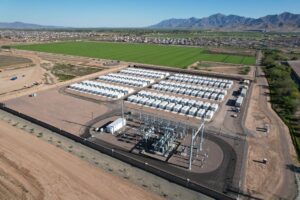
Mesa now has regulations in place for battery energy storage systems, including a 1,000 separation from residential developments and zones that industry lobbyists decried as excessive and hampering the ability to meet demand.
Council last week voted 6-1 to adopt fire and zoning code amendments, which included keeping these large-scale facilities in general industrial and heavy industrial districts, on-going sound studies and a compliance statement. Councilwoman Jenn Duff was the sole dissenter.
“I think the 1,000 feet is excessive,” Duff said prior to the vote. “In retrospect of understanding it’ll be approved, I’d like to consider bringing it back at another time when we had more time to look at studies and other effects to consider shortening that distance, maybe 400 feet, maybe 100 feet.”
Example of a battery energy storage system or BESS, which Mesa now has regulations for them.
She previously stated that the 1,000-foot separation was about the length of three football fields – land that could be used for economic purposes and not sit unused.
According to Duff, the separation should be at least 400 feet, on par with that for parks, churches, schools and other sensitive uses.
“We can certainly work with Council to determine what would be the appropriate time to bring this back,” City Manager Scott Butler responded.
Mayor Mark Freeman, who previously expressed reservation with the distance voted with the majority to approve it.
A battery energy storage system, or BESS, provides stability to the grid during peak demand periods, outages or emergencies and was not defined in Mesa’s zoning code.
Currently Mesa has one BESS – the Signal Butte energy storage project under construction by Salt River Project and Aypa Power. It will be able to power over 50,000 average-sized residential homes over a four-hour period when completed in mid-2026.
The city also has received pre-submittals for two more facilities – one at Signal Butte and the other at Ellsworth Road.
Councilman Rich Adams said that although he was sympathetic to Duff’s concerns, the amendments should move forward as presented.
“However, I think we should also continue to look at the issues surrounding battery energy storage systems,” he said. “The distances involved with the understanding that there is a lot of data out there that should be considered as technology advances. So, I’m supportive of this, with the understanding that we will be revisiting these standards as we go down the road.”
Vice Mayor Scott Somers, a retired Phoenix firefighter, said, “Under existing technologies and what’s unknown about future chemistries, having that 1,000 feet from someone’s home where they can’t always evacuate quickly is the right measure to do.
“I do understand that as things change, as more data comes in, we can re-examine this.”
Eight people spoke on the topic.
Resident David Winstanley, a retired Honeywell Aerospace engineering director, said he’s been involved in the investigation of two battery fire incidents on Boeing 787 aircraft.
“We learned from these investigations that battery fires are highly energetic, produce high-temperature gases that contain toxic chemicals depending on the chemistry of the battery and often have unintended consequences,” Winstanley said.
“The batteries that I investigated were 100 times more energetic than your typical phone or computer battery. But they’re 100 times less energetic than what we’re describing in the BESS systems. There’s a lot of energy potential and a safety risk.”
While attorney Court Rich, who represented Aypa Power, urged passage so projects in the pipeline can move forward, others in the industry did not.
“We are concerned about the viability of future battery energy storage system projects coming before the city should this proposed separation requirement move forward,” said Cepand Alizadeh, representing Arizona Technology Council.
“Mesa is growing. More land will be rezoned residential as more people seek to move into this community. Also, more technology companies and tech manufacturers will seek to set up operations in Mesa,” he continued.
“Battery energy storage systems will play a key role in fueling this future economic growth. By moving a 1,000- foot separation requirement forward, the City Council may harm the viability of Mesa as a tech hub for companies that want to locate here. If there’s not enough power, they will go elsewhere.”
He suggested council go with the Planning and Zoning Board’s recommendation for a 400-foot separation.
Buchanan Davis of SRP said that the utility company will be doubling its load in the next 10 years to supply demand.
“Battery storage is an important tool in the toolbox,” he said. “It keeps the lights on when demand is highest. It charges energy when it’s cheap and abundant and deploys it when we need it the most in those hours of the day when demand is the highest.”
He wanted council in future conversations to lower the 1,000-foot setback and include light industrial as a location for the facilities.
Kyle Whittier of NextEra Energy Resources, which has one of the two BESS proposals making their way through the city, said there’s full agreement that the safety of Mesa residents is the most important.
However, he said, the proposal restricting these facilities to certain areas and the 1,000-foot setback creates “unnecessarily and overly restrictive regulations,” adds cost to the customer and harms the ability of electric utilities to provide the needed energy to power homes, businesses, schools and hospitals.
Whittier said the National Fire Protection Association’s recommendation of 100 feet for BESS facilities is a gold standard and pointed out that Mesa relies on the group for many of its other codes.
Autumn Johnson with Arizona Solar Energy Industries Association called the proposed setback “arbitrary, unsupported by data and outside national best practice.”
“The American Planning Association reviewed best ordinances nationwide and found that jurisdiction-specific setbacks typically fall between 50 and 150 feet,” Johnson said.
“Put it plainly, if adopted as drafted, this would be the largest BESS setback in Arizona and to our knowledge, one of the largest in the United States.”
She warned that other municipalities would likely copy it to the detriment of the industry and customers.
“That being copied throughout the state will make electricity prices more expensive,” she said. “And it will make our grid less reliable.”
Amanda Curtis of Mormon Women for Ethical Government urged council to work towards an ordinance that follows the industry experts’ recommendations.
“We support BESS technology as an essential component of securing the stability and affordability of Mesa’s electric grid,” she said, adding that a 50- to 150-foot setback is what most jurisdictions use and was considered “a safe distance for BESS facilities.”
“This large setback would drastically reduce the availability of land with existing infrastructure to support interconnection of a BESS facility to the grid,” Johnson continued. “It would make the acquisition of appropriate land more difficult and expensive.
“The cost of the system itself would increase due to the longer roads and added wiring and cables needed for a larger-than-necessary setback.”
She said that BESS systems have significantly improved in recent years with better designs, innovations in battery chemistry, improved containment and enhanced fire safety standards.