Chetu Guest Blog Post: Why Private AI is the Future of Data Privacy in Business
By Rick Heicksen
Vice President of Sales at Chetu
A massive boon for industries across the board, artificial intelligence (AI) has eliminated countless hours of costly and tedious work by streamlining or automating processes that previously required human labor.
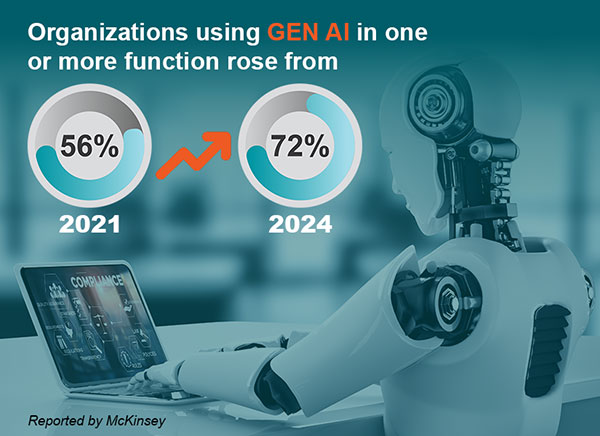
The percentage of companies utilizing gen AI in one or more functions increased from 56% in 2021 to 72% in early 2024, according to the latest McKinsey research.
Still, among the most pervasive questions hanging over the fledging field is the issue of privacy. Can AI platforms, the lifeblood of which is often drawn from public information outlets, really be trusted to safeguard data in a manner consistent with client expectations and, in some instances, government regulations?
One potential solution is Private AI or AI Enterprises. This approach avoids the shared spaces and cloud-based arrangements of public AI models like ChatGPT or Google Gemini in favor of a more secure paradigm that elevates confidentiality and data privacy.
Not only does this emphasize best practices for proprietary and client information, but it can also help cultivate a more regulatory-friendly approach, a concern as stricter regulations come increasingly into play whether through American health care laws like the Health Insurance Portability and Accountability Act (HIPAA) or European data security rules like the EU’s General Data Protection Regulation (GDPR).
More privacy isn’t the only benefit
The simple advantage of Private AI isn’t difficult to see. Information requiring AI analysis or usage does not need to be spread to other platforms or released to third-party providers. Data custody can remain under the company’s roof. That leaves less danger of it escaping beyond an organization’s oversight.
That extra measure of control can also afford the company the opportunity to avoid other pitfalls associated with public AI models. For instance, bias is a persistent issue in AI. Still, when an organization can choose the training data and create its own guidelines related to ethics and maintain anonymity, a tighter handle on the information might mean the ability to reduce inherent biases that could harm marginalized groups. In contrast, internal developers can create useful measures to understand and test for prejudices that could otherwise go unnoticed.
Who can benefit from Private AI adoption?
While Private AI has many potential use cases and applications, four industries stand out as top contenders:
- Finance: Money is one area where everyone wants their information protected. However, it is also a place that can profit from artificial intelligence. Hence, Private AI is a natural fit. Important data can remain protected within the organization while AI hunts for illegal or fraudulent transactions and assesses risks more easily than a human can. Mundane tasks related to loan processing or KYC verification can be delegated to AI while avoiding exposure of customer data.
- Healthcare: Patients expect privacy. More importantly, so does the law. From doctor discussions to clinician notes, everything is charted and ends up as data that must be kept safe. Private AI eliminates the need to move electronic health records off-site to access powerful AI tools that are revolutionizing care. AI’s growing role in hospitals and clinics is unlikely to ebb, and it will be the responsibility of administrators to utilize its power to help diagnose illness, create treatment plans, and manage care without compromising the data privacy that every patient deserves and regulations like HIPAA mandate.
- Manufacturing and retail: It isn’t just bankers and doctors who are using AI products. Increasingly complex and fragile supply chains are creating strong pressures to keep a closer eye on inventory management than in the past, and storefronts, big and small, can look to predictive algorithms to forecast demand before customers even walk in the door. Keeping that kind of information from leaking out into the hands of competitors has never been more vital.
- The Law: If there is one area that demands confidentiality, it is the legal arena where custody of data is paramount, and breaches of information can lead to ethics complaints or worse. Yet, AI’s vast benefits may be greatest for lawyers where painstaking research into cases, contracts and compliance issues can consume massive amounts of billable hours for attorneys and paralegals alike. Promoting internal processes through Private AI can harness its abilities to handle mundane housekeeping work without forcing information onto external platforms.
How does Private AI really work?
Several components can make up Private AI including natural language processing, generation and understanding as well as semantic and deep learning. It utilizes self-learning and real-time analytics to create greater efficiency, reduce workload, and support smarter choices through a variety of features. Data privacy ensures that both the data and the AI models they train on remain within the organization’s control while differential privacy and homomorphic encryption can create greater security. Meanwhile, Edge AI keeps information away from cloud-based platforms, which ensures that it stays more secure.
Private AI can also be customized to tailor itself to individual businesses so that there are no one-size-fits-all solutions. Plus, AI models can train on decentralized data through a process called Federated Learning.
However, those who want the power and accessibility of public AI may also wish to examine Hybrid AI models which works to combine the power of public paradigms with the control of private models. Where securing data is paramount, Private AI may be the best choice. But some information provides less risk for exposure. In these cases, public AI might work just as well.
Use cases

Private AI is making clear headway in the field. When Acme Financial found itself dealing with problems related to excessive fraud, the bank used its records to create its own product to sniff out difficulties. In just half a year, fraud detection rose by 35 percent and false positives fell by a fifth.
Department store Target is a success story for implementation of a hybrid AI solution. It does indeed take advantage of public AI chatbots in dealing with the day-to-day demands of its consumer base. However, the enterprise used customer data to build a Private AI solution for functions like inventory or personalized recommendations. The results were unambiguous. The company celebrated a 15 percent boost in satisfaction rates for customers while costs for inventory dropped by a tenth.
These aren’t isolated cases. In fact, the Enterprise AI Initiative documented that more than seven out of every ten companies saw improved task-specific accuracy with use of Private AI versus their public counterparts.
Whether it is Private AI, public AI or a hybrid solution composed of both, artificial intelligence is changing the way business works in fields from healthcare to retail. Deciding the correct blend of components for an individual organization is no easy task. That’s true even when a company knows its needs and has the best personnel.
For many organizations, Private AI presents a new way to keep privacy and security at the top of mind while still taking advantage of the revolutionary cutting-edge tools that are completely reshaping industry after industry by creating greater efficiencies than anything that could have been imagined just two decades ago.
Contact a software service provider with extensive experience in AI development to help your business implement the right Private AI system to meet your needs.
Based in Tempe, Rick Heicksen is the Vice President of Sales at Chetu, a global software solutions and support services provider.
About Chetu: Founded in 2000, Chetu is a global software solutions and support services provider. Chetu’s specialized technology and industry experts serve startups, SMBs, and Fortune 5000 companies with an unparalleled software delivery model suited to clients’ needs. Chetu’s one-stop-shop model spans the entire software technology spectrum. Headquartered in Sunrise, Florida, Chetu has 13 locations throughout the U.S., Europe, and Asia. For more information, visit www.chetu.com.