
Arizona ranks No. 2 in US for new energy storage capacity added this year
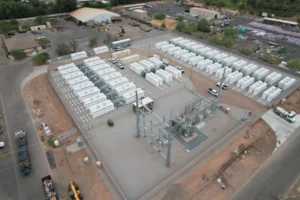
Arizona is proving to be a national leader in utility-scale energy storage capacity, with the second-highest amount installed so far this year and one of the highest amounts in total.
A report released earlier this month from the Solar Energy Industries Association, or SEIA, along with Benchmark Mineral Intelligence found that 940 megawatt-hours of energy storage was installed in the Grand Canyon State during the first quarter, an amount surpassed only by the 2,696 megawatt-hours added in Texas and slightly ahead of the 936 megawatt-hours added in California.
That Q1 addition brings Arizona to a milestone total of more than 20 gigawatt-hours of utility-scale energy storage installed — 20.2 to be exact. That is the third-highest amount in the U.S., behind California (60.6) and Texas (29.2). Arizona also ranked third after 2025, when it led the nation for its rate of growth in energy storage.
The top five states in the latest report were rounded out by Nevada (6.3) and New Mexico (4.2).
Arizona now is home to three of the 10 biggest battery storage system (BESS) projects in the U.S. The TransGrid Atlas VII BESS, Papago Storage Project and Sun Streams 4 Solar + Storage Project each have 1,200 megawatt-hours of storage capacity to tie for Nos. 8-10.
The average storage project size in Arizona is 434 megawatt hours. The state’s storage capacity is divided about half-and-half between standalone and solar power.
Arizona’s project pipeline continues to add capacity. As one recent example, nonprofit Valley utility Salt River Project in March announced a joint project with power infrastructure development firm Invenergy to add 200 megawatts of four-hour battery storage to the Valley’s grid at the SunDog Energy Center in Pinal County.
Arizona expects to ramp up installations in 2027 and beyond
The SEIA report projects Arizona’s new installations this year will roughly match what came online last year, with about 10 gigawatt-hours to be added in 2026. However, more than 20 gigawatt-hours are seen in the pipeline for 2027 and beyond, effectively doubling the current capacity, according to the report, and the 2030 forecast could bring Arizona to a cumulative 66 gigawatt-hours of storage capacity, beyond California’s current level.
Nationally, the energy sector added about 10 gigawatt-hours of storage capacity, which the report said is the most ever added in a first quarter, demonstrating the accelerating pace of those projects. About 7.8 gigawatt-hours of that total was utility-scale, with the rest being commercial and industrial or residential.
Nonetheless, the report added that politically motivated federal permitting delays or cancellations threaten more than 460 solar and storage projects. Those challenges in turn threaten to make power for average customers more expensive as demand on system increases with the pace of technological advances.
“Energy storage is no longer just for backup, it’s critical energy security infrastructure,” said Shan Tomouk, BESS and Energy Lead at Benchmark Minerals. “A supportive policy landscape for BESS will be crucial to enabling the rollout of AI and data centers, while mitigating adverse cost impacts to regular consumers.”