
Pipeline Design & Engineering Guest Blog Post: When to Break the Rules of DFM
Pipeline Design & Engineering, LLC
Design for Manufacturability (DFM) is one of the most important disciplines in product development. It gives engineers a framework of best practices—like adding draft angles to molded parts or respecting depth-to-diameter ratios for drilled holes—that keep designs efficient, reliable, and cost-effective to produce.
But here’s the truth: rules are guidelines, not laws. Every product comes with unique constraints, and sometimes the path to the best solution requires bending—or even breaking—the “rules” of DFM. The key is knowing when it’s safe to do so, and what tradeoffs you’ll face.
Example 1: Injection Molded Draft Angles
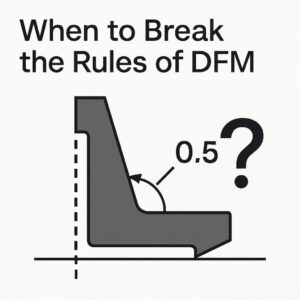
Standard guidance says molded side walls should include 1–3 degrees of draft. This makes it easier for the part to eject from the mold without scuffing, binding, or requiring excessive force.
But what if the design requires a nearly vertical wall for functional or cosmetic reasons? Can you get away with only 0.5 degrees of draft?
Yes—with caveats.
- Tooling: Expect your mold to require more precise machining and polishing to reduce drag.
- Material: Certain resins release more easily than others. Glass-filled polymers, for example, will be less forgiving.
- Maintenance: The mold will wear faster, especially at high volumes. Plan for more frequent maintenance and possibly shorter tool life.
If the design absolutely requires it and the volumes are moderate, 0.5 degrees may be acceptable. For mass production, though, you may be trading short-term performance for long-term cost.
Example 2: CNC Drilled Hole Ratios
A common rule of thumb in machining is the drilled hole depth-to-diameter ratio of 1:4. A 0.25″ hole should not exceed 1″ in depth without special considerations. Beyond that, chips don’t clear easily, heat builds up, and tools risk breaking.
But sometimes, the design calls for a 1:6 or even deeper ratio. When can you push this rule?
Here’s how it’s done in practice:
- Tooling: Use a high-performance drill bit with specialized coatings.
- Process: Break the drilling into steps, backing out frequently to clear chips.
- Coolant: High-pressure coolant delivery becomes essential to manage heat.
- Cost: Tool wear goes up, cycle times go up, and part cost follows.
You can absolutely drill deeper than 1:4, but every inch beyond the standard ratio multiplies the risks. This decision is usually justified only when design alternatives (like redesigning for a shorter hole or using a two-part assembly) aren’t viable.
General Principles for “Breaking” DFM Rules
- Understand the why. DFM guidelines exist for good reasons: they protect part quality, tool longevity, and cost efficiency. If you’re going to break one, know exactly what failure mode you’re risking.
- Balance risk and reward. Sometimes aesthetics, ergonomics, or functional performance outweigh manufacturability. If the payoff is a critical user benefit, the tradeoff might be worth it.
- Lean on process expertise. Partner closely with your manufacturer. A moldmaker may have tricks to polish away draft-related scuffing, or a machinist may suggest tool modifications to safely go deeper with a drill.
- Prototype and validate. Don’t move straight to mass production. Test your edge-case design choices early to confirm whether the risks are manageable.
Learn When (and How) to Bend the Rules
At PDX 2025, Fictiv, a pillar in the world of manufacturing, will share practical principles on when to break DFM rules, what tradeoffs to expect, and how to make those decisions intelligently. This is the kind of real-world, graduate-level engineering insight you won’t get from a textbook.
If you’re a growth-minded engineer looking to sharpen your practical skills and expand your playbook, join us in Phoenix this October 21–22 at the Mesa Convention Center for two days of hands-on training, peer networking, and expert-led sessions.
Register now at PDX 2025 Registration