
Chetu Guest Blog Post: AI Chatbots and Agentic AI Offer Different Solutions that Save Money for Businesses
By Rick Heicksen
Director of Sales at Chetu
The truth about Artificial Intelligence (AI) is that one size doesn’t fit all, and versatility doesn’t mean interchangeability. As AI comes increasingly to the fore, it is imperative to understand the different aspects of this emerging technology so your enterprise can find the correct solution to meet its needs.
What is a Chatbot?
Chatbots are not new. However, they are more exciting, flexible, and interactive than ever before. Thanks to machine learning, responses are less automated and more personalized than in the past. That is true in everything from answering customer support calls to generating leads from your Internet presence. Most importantly, this is the time to make the move. Other businesses are changing their game plans to include chatbots. Those who fail to do so risk being left behind.
Erica, Bank of America’s Chatbot
Examples of successful chatbots already abound – even in staid traditional fields like finance. At Bank of America, cognitive messaging and predictive analytics have already given birth to a chatbot named Erica, which is credited with driving 19% of the bank’s earnings growth. Erica doesn’t just lend a hand with transactions like the recorded messages of the past. She gives guidance on an individual level that can help customers save money. This results in happier consumers and more efficient, productive interactions.
What is Agentic AI?
But AI chatbots aren’t the end of the line when it comes to machine learning, deep learning, and reinforcement learning models. Welcome to the world of Agentic AI, where AI solutions make decisions independently and without any guidance from humans. With a stronger ability to comprehend nuance, Agentic AI can do more than analyze or collect data. It can select choices to complete processes on its own.
This is important in areas like supply chain management, so companies know what they have on hand in the warehouse, what sales figures are likely to look like next month, and, most importantly, when they should reorder inventory. Better yet, the more data agentic AI collects, the more efficient it becomes.
In fact, Accenture now forecasts that AI agents will take the place of humans as the principal users of most enterprise systems by 2030. KPMG released a survey of executives at large enterprises, which revealed that 12% of companies are already using AI in this fashion.
Agentic AI in Cybersecurity
Agentic AI can also be bad news for bad actors. Cybersecurity enterprise Darktrace already utilizes it not only to locate potential threats in real time but also to react to them as well. This frees up humans to tackle even more advanced problems.
Forrester Research says that nine out of every 10 businesses expect agentic AI to impact their competitive advantage within the coming five years.
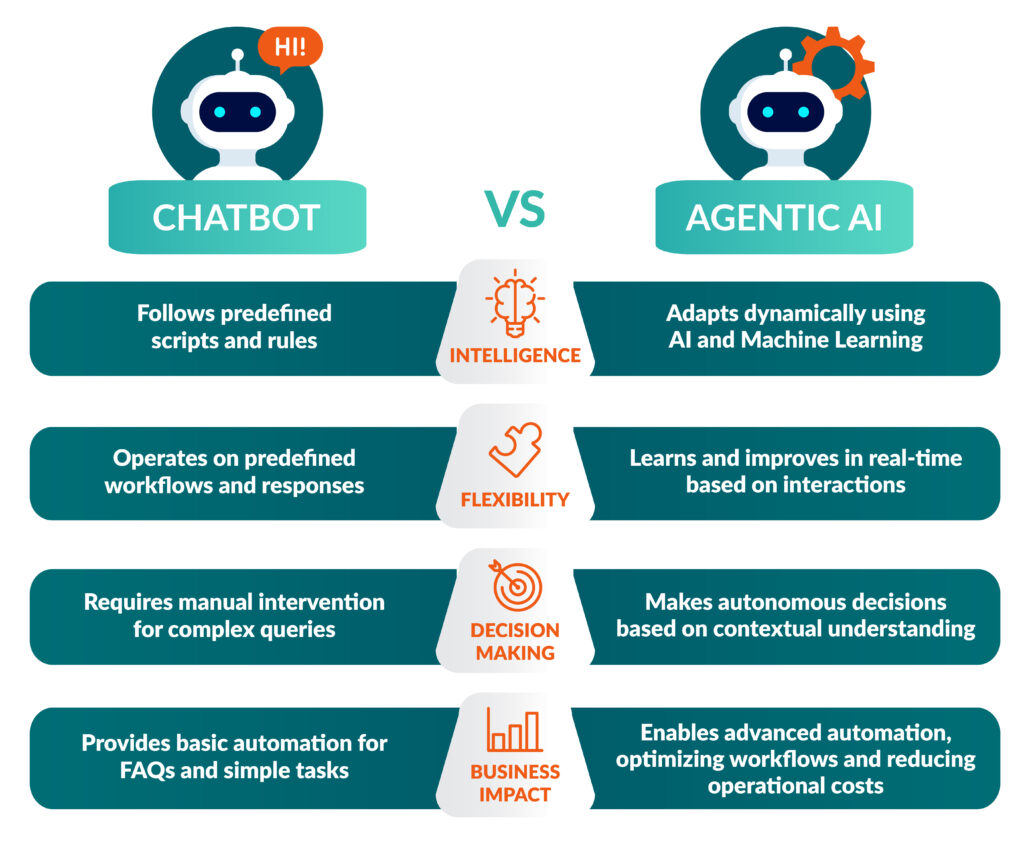
Key Differences Between Chatbots and Agentic AI
Real-World Cases
As noted earlier, various AI technologies have different uses. Determining when to employ a chatbot and when to utilize a full-fledged agentic AI solution are crucial questions that your company or organization must ask.
AI Chatbot Use Cases:
Customer Service FAQ: This is among the lowest-hanging fruit for a chatbot. Common questions can yield quick answers and happier customers while decreasing traffic that might otherwise fall on live operators.
Basic IT Support: Not every problem requires a human to be on the other end of the phone. Simple difficulties can make use of chatbots to reset a password or diagnose a printer that refuses to connect.
Appointment Scheduling: Another good use of chatbots is the simple but important task of keeping a calendar. A physician or other professional can utilize a chatbot to collect basic data and make appointments without human intervention.
Agentic AI Applications:
Personalized Assistant: Of course, some tasks are perfect for Agentic AI. Personal assistants have long been a staple for busy people, but today there really is an app for that. An AI agent can create better processes by understanding how users like their calendar set or how messages are sorted.
Optimize Workflow: AI agents excel at tedious tasks, and this form of AI can easily automate activities that would otherwise require a human to engage in dull, iterative processes.
Intelligent Support: People cannot always see the forest for the trees. But AI agents can translate any data jungle into a more orderly picture. Pattern recognition is basic to AI, and its strength at drawing actionable conclusions from a mess of information is one of its strengths.
5 Reasons Businesses Should Adopt Agentic AI
Increasingly, Agentic AI seems to be taking over the field formerly dominated by chatbots, probably due to its more advanced capabilities.
Gartner® predicts that “by 2028, 33% of enterprise software applications will include agentic AI, up from less than 1% in 2024, enabling 15% of day-to-day work decisions to be made autonomously.” This comes as no surprise, as companies gain higher efficiency, improved customer engagement, scalability, and automation, as well as increased conversion rates. Unlike generative AI, agentic AI can specialize in vertical-specific use cases, solving niche problems in an industry.
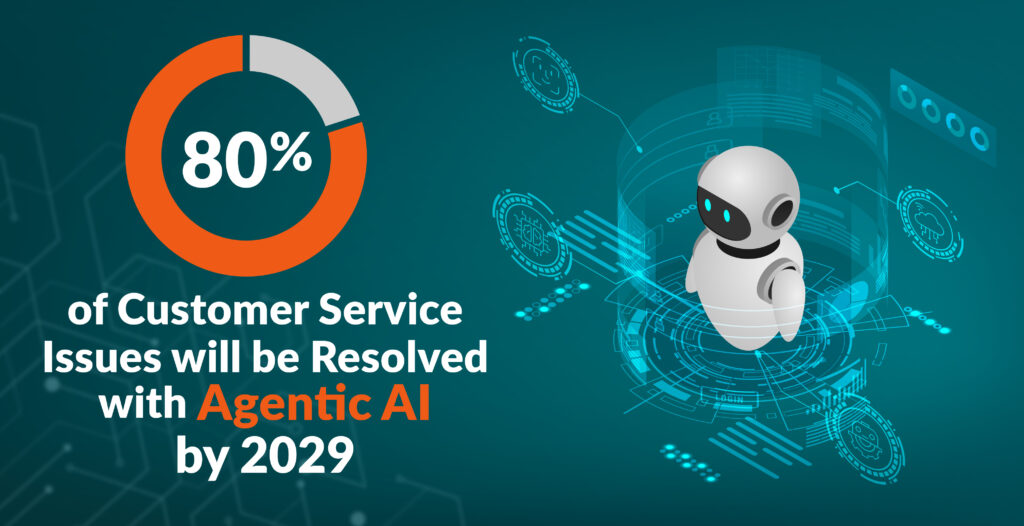
- “By 2029, agentic AI will autonomously resolve 80% of common customer service issues without human intervention, leading to a 30% reduction in operational costs, according to Gartner, Inc.”
- Accenture notes that AI decreases the number of errors in customer service operations, which could bring down expenses and improve the customer experience.
- An IBM report optimistically predicts that AI-driven work reduces decision-making time by up to 50%.
- Salesforce Research reports that predictive analytics introduced by AI agents can offer customization at a level never seen before, while Deloitte predicts a possible increase in customer retention by as much as 25%.
- McKinsey indicates that businesses using AI for customization have seen increases in sales by up to 15%.
There are many companies that have already seen AI totally change their operations. That process is only likely to accelerate as time goes on.
Sources
- Gartner, Intelligent Agents in AI Really Can Work Alone. Here’s How., October 1, 2024
- Gartner Press Release, Gartner Predicts Agentic AI Will Autonomously Resolve 80% of Common Customer Service Issues Without Human Intervention by 2029, March 5, 2025 (https://www.gartner.com/en/newsroom/press-releases/2025-03-05-gartner-predicts-agentic-ai-will-autonomously-resolve-80-percent-of-common-customer-service-issues-without-human-intervention-by-20290)
- GARTNER is a registered trademark and service mark of Gartner, Inc. and/or its affiliates in the U.S. and internationally and is used herein with permission. All rights reserved.
Based in Tempe, Rick Heicksen is a Director of Sales at Chetu, a global digital intelligence and software solutions provider.
About Chetu: Founded in 2000, Chetu is a global digital intelligence and software solutions provider. Chetu’s specialized technology and industry experts serve startups, SMBs, and Fortune 5000 companies with an unparalleled software delivery model suited to clients’ needs. Chetu’s one-stop-shop model spans the entire software technology spectrum. Headquartered in Sunrise, Florida, Chetu has 13 locations throughout the U.S., Europe, and Asia.