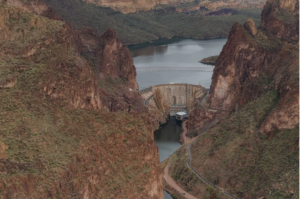
SRP officials want to pursue this on the Salt River system northeast of metro Phoenix. Their plan would create an upper reservoir above Apache Lake, which would be used as a lower reservoir. Water would flow to and from the upper reservoir and the lake.
Along with the new reservoir, the plan would require the installation of roughly 100 miles of new transmission lines and other infrastructure to connect this giant hydro battery to SRP’s electric grid at a substation near San Tan Valley.
“We are seeing solar technology getting better,” said Ron Klawitter, manager of water power projects at SRP. “The project is really motivated by that.”
A costly, impactful project
The investment would be substantial, probably costing several billion dollars, Klawitter said. It also would require approvals from various entities from the U.S. Forest Service and federal Bureau of Reclamation to the Arizona Corporation Commission, while seeking the blessing of local towns, Native American communities and others.
SRP recently wrapped up a series of informational meetings with some stakeholders, and Klawitter said the reaction has been mostly favorable. SRP will hold more meetings, open to the public, early next year. The company provides more details about the project and the public-input process on its website, srpnet.com.
The U.S. House of Representatives in November overwhelmingly passed a bill that enables further evaluation of the project. The legislation was co-sponsored by Reps. Greg Stanton, D-Ariz., and David Schweikert, R-Ariz. The Senate is considering it.
SRP already produces hydropower, equivalent to about 265 megawatts, enough to power about 60,000 average-sized homes. The proposed Apache Lake “pumped storage” project could add another 1,000 to 2,000 megawatts of electricity. That would be enough power for 225,000 to 450,000 homes.
SRP anticipates that it will need 4,000 megawatts of additional power to meet projected demand by 2033 and to replace coal-powered generating sources that will be phased out. The 1,000 to 2,000 megawatts from the proposed hydro project would replace about one-fourth to one-half of that gap, with solar providing most of the rest.
How a hydro ‘battery’ would work
Increasingly, electric utilities are harnessing solar power and storing some of this energy in conventional, industrial-size batteries. SRP is doing this, and so is Arizona Public Service. However, the hydro-storage project at Apache Lake is expected to have a much longer life, and it sidesteps lithium mining and other environmental hazards that come with conventional batteries.
SRP would build up energy by pumping water into the upper reservoir, then release it to the lake over roughly a 10-hour frame, from evening to morning. The utility would need to install new hydropower turbines.
SRP is considering two sites for the upper reservoir above Apache Lake that would require a tunnel for pumping the water uphill that would run about three-quarters of a mile, with an elevation gain of about 1,000 feet.
“For the most part, it would be a very big facility that’s hidden under a mountain,” Klawitter said, adding that both location options involve roughly the same distance, elevation gain and tunnel size.
SRP also would need more transmission lines. The utility would seek approval from the Arizona Corporation Commission for segments that run across private and state land. The rest of the infrastructure, including the new reservoir, would be located on federal land in the Tonto National Forest, requiring approvals from the U.S. Forest Service and the Bureau of Reclamation, Klawitter said.
Decade-long timetable
Over the next few years, SRP plans to select sites, design the project and apply for necessary permits and approvals.
Tunneling and construction of transmission lines and other infrastructure would start about 2027 and finish several years later, with the project expected to start producing power by about 2033.
Total project expenses haven’t been determined yet. The design process will help to pinpoint those costs, the expenditure schedule and any potential rate increases for SRP customers, Klawitter said.
While SRP hasn’t chosen the reservoir location, the areas under consideration have a high desert topography. The reservoir selected would enclose about 20,000 acre feet of water and span “a couple hundred” surface acres, he added.
“You need the right topography and an available water supply,” he said. “But solar is really where the project comes in.”