
How SRP’s planned new reservoir in Arizona would work like a ‘giant battery’
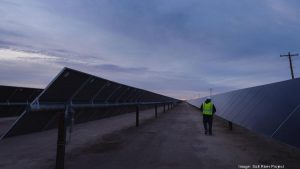
Salt River Project continues to move forward with a proposed solar and hydropower project east of Mesa that could generate enough electricity to power up to 450,000 homes in the coming decades.
Metro Phoenix will likely face substantial new energy requirements, especially from sources that don’t release emissions.
The proposed project, if completed as envisioned in public workshops held in early May, would release water from a new upper reservoir into Apache Lake, spinning turbines to generate power over potentially 10 hours during high-demand periods in the late afternoon and early evening.
When demand subsides during the morning and around midday, the same turbines would spin backward and pump water to the upper reservoir located at an elevation of perhaps 1,500 feet higher, using solar energy that’s typically not needed in high quantities at that time of day.
This “pumped storage hydropower project” could be operational by around 2033.
The project will cost “several billions of dollars,” ultimately paid by SRP customers, said Joseph Gardner, a project manager for the Tempe-based utility.
SRP will seek environmental and other approvals from the Bureau of Reclamation and other federal agencies, with the Arizona Corporation Commission needed to approve the siting of around 80 miles of transmission lines that would connect to existing SRP infrastructure.
Some of the federal and state permitting could start later this year, but environmental clearances and possible archeological sites likely would take at least two years. Construction could begin in late 2027 or early 2028, Gardner said.
SRP still needs to decide on some details
SRP hasn’t yet determined which of the three types of transmission lines it will use as it continues to receive public comments on it and other features. The design and placement of transmission lines could impact the views of residents in small nearby communities.
Nor has SRP determined other key features, including how big of a project to undertake, in part so that it doesn’t interfere with other operations such as delivering water to customers in metro Phoenix.
The utility also has to figure out where exactly to locate the upper reservoir, which hasn’t been named and likely won’t include any recreational amenities.
The upper reservoir could measure 250 to 300 surface acres when fully flooded. Its elevation would drop roughly 100 feet when power is released in the afternoon and evening hours, filling back up to the initial level during morning hours.
The new reservoir would function as a “giant battery,” Gardner said. “It’s designed to fill to capacity and drain to capacity.”
SRP plans to utilize safeguards to minimize the risk that fish could get sucked into the pipes or turbines.
SRP already operates similar hydropower facilities at the Horse Mesa and Mormon Flats dams and elsewhere, generating about 265 megawatts in total, meaning the new project could be four to eight times as large.
Connecting hydro power with surplus solar electricity
The energy required to pump the water back upstream would exceed that generated when water is released.
“Of the energy we put in, we’d expect to get about 80% of it back,” Gardner said.
The power consumed by pumping would be generated by solar panels during times of the day when much of it wouldn’t be needed otherwise, especially as more solar generation comes online.
This “roundtrip efficiency” of 80%, he said, is consistent with other technologies such as solar panels that send energy to be stored in giant batteries for release later in the day.
Gardner noted that SRP has a long history of storing water for reliable release, using it, in part, to generate electricity.
The new project “would be a big part of that, on both the water and energy sides,” he said.