
Raytheon to ramp up Tucson production after landing multiyear missile deals
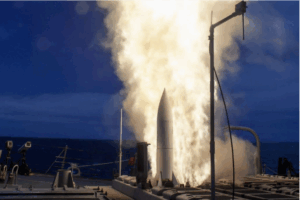
Raytheon’s manufacturing output in Tucson is set to ramp up for the next several years after the RTX division hammered out a set of agreements with the U.S. Department of War to supercharge production capacity and deliveries of five key munitions.
Under the series of agreements announced last week, Raytheon will significantly increase annual output of the following missiles:
- Land Attack and Maritime Strike variants of Tomahawk missiles: These weapons are launched from ships and submarines and can maintain precision from a range of 1,000 miles and through heavily defended airspace, Raytheon said. Production will increase to more than 1,000 units annually.
- AMRAAM missiles: These air-to-air missiles are the most widely deployed in the world, Raytheon said. Production will increase to at least 1,900 units a year.
- Standard Missile-6 units: These missiles function for anti-air, anti-surface and sea-based terminal defense. They are fired from ships and from launchers on land. Production will increase to more than 500 units annually.
- Standard Missile-3 IIA production will also increase and Standard Missile-3 IBproduction will accelerate, the company said without specifying numbers. The SM-3!B is used for exoatmospheric interception of short-to-intermediate-range ballistic missiles and is launched from ships or land. The SM-3 IIA has larger rocket motors and an enhanced kinetic warhead to add speed and range; it was created in conjunction with the Japanese military.
Raytheon noted that, in some of the cases, the new deals will boost production by two to four times the existing production rates. Each of the agreements has a lifespan of up to seven years, and the anticipated work means that RTX will make more investments in facilities, workforce and technology to keep up with the increased output.
“These agreements redefine how government and industry can partner to speed the delivery of critical technologies and are a direct result of the administration’s Acquisition Transformation Strategy and commitment to deliver the best technologies faster,” said Chris Calio, CEO and Chairman of RTX (NYSE: RTX), in a statement. “We are proud to support the department’s Arsenal of Freedom to ensure the United States and its allies and partners have the decisive edge — now and in the future.”
In addition to the Tucson operation, where Raytheon’s missile operation is based, work connected with these agreements will also take place at Raytheon facilities in Alabama and Massachusetts.
Also last week, Raytheon said that it had successfully completed a test of its next-generation shoulder-fired missile for the U.S. Army using new technology that would replace the aging and ubiquitous Stinger missile.
Raytheon is one of Arizona’s largest defense contractors, notching more than $55 billion in contract value during the last fiscal year. That was bolstered by a number of multibillion-dollar contracts awarded in 2025