
Phoenix-based Honeywell Aerospace to go its own way amid company split
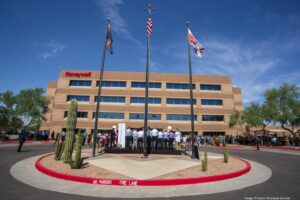
Phoenix-based Honeywell Aerospace Technologies is going to become a separate entity now that Honeywell International Inc. (Nasdaq: HON) plans to follow through with a major shake-up, splitting its businesses into three publicly traded companies.
The Charlotte, North Carolina-based conglomerate announced Thursday before the markets opened that it would separate its aerospace business, based in Arizona, and its automation unit. The action comes after Honeywell announced in December it would consider the separation after calls to do so in November from Elliott Investment Management. The separation is expected to be completed in the second half of 2026.
Honeywell Aerospace is Arizona’s second-largest defense contractor, with just under 2,000 contracts in fiscal year 2024 valued at a total of $657.58 million, according to Business Journal research. With 7,124 employees in the state in 2023, Honeywell Aerospace ranked as Arizona’s 23rd largest employer last year.
A company spokesman in Phoenix told the Business Journal that local officials did not have a statement to offer as of Thursday evening, but he did confirm that Honeywell Aerospace’s headquarters would remain in Phoenix and that no workforce changes are planned.
Honeywell CEO Vimal Kapur said the timing is right for Honeywell Aerospace to go its own way.
“As Aerospace prepares for unprecedented demand in the years ahead across both commercial and defense markets, now is the right time for the business to begin its own journey as a standalone, public company,” Kapur he said in the statement. “Today’s announcement is the culmination of more than a century of innovation and investment in leading technologies from Honeywell Aerospace that have revolutionized the aviation industry several times over. This next step will further enable the business to continue to lead the future of aviation.”
Honeywell already announced last October plans to spin off its advanced materials business into an independent, publicly traded company. The changes are part of a larger portfolio review and reconfiguration spearheaded by Kapur, who took over the post in 2023.
“The formation of three independent, industry-leading companies builds on the powerful foundation we have created, positioning each to pursue tailored growth strategies, and unlock significant value for shareholders and customers,” Kapur said. “Our simplification of Honeywell has rapidly advanced over the past year, and we will continue to shape our portfolio to create further shareholder value.”
Activist investor Elliot acquired massive Honeywell stake
Elliott wrote a letter to Honeywell in November arguing for the separation of the automation and aerospace businesses. The letter was sent after Elliott amassed a more than $5 billion stake in Honeywell. Elliott argued the separation “could result in share price upside of 51-75% over the next two years.”
Writing at the time specifically about the Phoenix-based aerospace division, Elliott said it stands out as a “crown jewel” that’s benefiting from a “long tail of captive aftermarket sales” while investing in technology for future growth. Honeywell’s aerospace division has generated 43% of the company’s profit but received just 10% of merger and acquisition dollars over the past 20 years, Elliott said in its letter.
What’s more, he noted, Honeywell Aerospace’s operations are functionally separate from the larger company as it has its own management team, physical headquarters, manufacturing systems, product development, supply chain and financial reporting systems.
Honeywell said spinning off the businesses would be conducted “in a manner that is tax-free to the Company’s shareholders.”
Kapur has led an aggressive reshaping of Honeywell’s portfolio since taking over as CEO in 2023. He rolled out a reorganization plan in October 2023 to focus on three “megatrends” in automation, energy transition and the future of aviation. Several major transactions have followed to abide by that plan.
Last November, Honeywell announced a deal to sell its Personal Protective Equipment business for $1.325 billion. In July of last year, Honeywell agreed to buy a liquid natural gas business for $1.8 billion. The company bolstered its defense business in June 2024 with a $1.9 billion acquisition. Honeywell executed Charlotte’s largest acquisition deal of 2023 when it agreed to buy Carrier Global Corp.’s security business for $4.95 billion in December of that year.
“In 2024, we also made significant progress optimizing Honeywell’s portfolio,” Kapur said. “We completed four strategic bolt-on acquisitions representing $9 billion in capital deployed and announced two key divestitures in alignment with our portfolio simplification strategy, including the planned spin of our Advanced Materials business. As we look toward 2025, I am confident that our revitalized portfolio optimization strategy, established history of operational excellence and robust installed base will unlock further value creation for our shareholders, customers, and employees.”
Honeywell on Thursday reported that it beat analysts’ estimates for earnings and revenue in the fourth quarter. The company reported adjusted earnings per share of $2.47 for the quarter, which was down 8% year over year but beat estimates of $2.32. Honeywell recorded fourth quarter sales of $10.1 billion, which was up 7% over the year. Honeywell reported net income of nearly $1.3 billion for the fourth quarter.
Honeywell shares slumped on the news, losing 5.6%, or $12.53, to close at $209.82 on Thursday, but stemmed the losses and moved slightly higher in after-hours trading.