
9 months in: How Amazon’s drone delivery service is doing in Phoenix
Story Highlights
- Amazon launched drone delivery in Phoenix, serving 7-mile radius
- FAA approved Amazon’s drones to fly beyond visual line
- Amazon plans to expand drone delivery to other cities
About nine months ago, Amazon launched its first drone delivery service for customers in Phoenix out of its warehouse in Tolleson.
Residents within a 7-mile radius of the warehouse, located right off the I-10 and North 107th Avenue, can get small items weighing five pounds or less delivered in an hour.
The novel operation is teaching the company lessons it hopes will help it replicate the service elsewhere, while also reinforcing why Phoenix was an ideal starting point. A favorable regulatory environment, strong presence of existing Amazon facilities nearby and excited customers willing to pay a $9.99 service fee have lent to its success so far.
“You have the same-day sites here, you have the product here, not to mention you have customers here, and customers that are really tech savvy,” said Zoe Richmond, an Amazon spokesperson.
During a rare cloudy, windy Phoenix morning last week, the 14-drone fleet was grounded for deliveries but was expected to start back up again in the late morning. They operate during daylight hours — typically 8 a.m. to 6 p.m. — during the summer, aided by a team of drone-wranglers who place packages in a compartment and ensure they are safe and ready for takeoff.
Customers choose from over 50,000 items available for drone delivery, though the most popular items so far have been batteries and children’s medicine, Richmond said.
The company declined to say exactly how many drone deliveries it has made so far out of the Tolleson facility, though Amazon’s goal is to have 500 million packages delivered by drones globally by the end of 2029.
Texas, Missouri sites up next for drone deliveries
Amazon is planning to expand the service in two U.S. cities in the near future – in San Antonio, Texas, and in Kansas City, Missouri. It also already has an operational drone delivery testing site in College Park, Texas.
One key component making drone deliveries possible in Phoenix are approvals from the Federal Aviation Administration. Amazon received approval from the FAA to fly its MK 30 drones, with 6-foot wingspans, beyond a pilot’s visual line of sight — meaning the company can operate the technology without being able to see the drones directly.
Amazons’ footprint in the West Valley, a burgeoning hub for logistics and warehousing users, is also key to the operation.
Last year, Amazon signed a 10-year lease for a 1 million square foot building at the Paloma Vista Logistics Center in Buckeye, a 1.2 million square foot lease at The Cubes at Glendale Industrial Park and 1.2 million square feet at the Prologis 303 Business Park in Goodyear.
Those warehouses play different roles in part of the logistics operation. Several are where products are initially delivered from suppliers, then sorted, and sent off to other warehouses. The Tolleson facility is typically the last place an item goes before its out for delivery.
Tolleson facility boasts other new tech, robotics
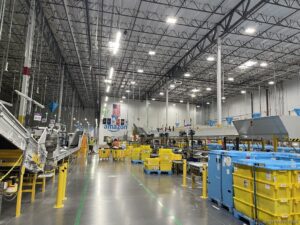
The Tolleson facility is home to a variety of new technologies Amazon is using beyond just drones. It includes a same-day grocery delivery operation – bananas are apparently the most popular item ordered – and is also where new robotics capabilities have recently come online.
On June 30, CNBC reported that Amazon said it now has one million worker robots deployed across its entire footprint, with more artificial intelligence capabilities on the way to increase their capabilities.
A small army of four-sided, roughly 7-feet tall robotic storage units whiz around the warehouse in Tolleson, getting stocked with items and delivering them to workers who package them and send them off for delivery drivers to pick up.
Traditionally in warehouses, a human would have to walk through a massive building to find certain items customers had ordered. Now, the robots are stocked with items that Amazon’s technology predicts customers are most likely to order.
Still, CNBC reported that the move comes at a time when more tech companies are cutting jobs and warning of the effects of automation on worker hiring.
Amazon workforce has seen reductions
CNBC reported that in a memo to employees earlier in June, Amazon CEO Andy Jassy admitted that he expects the company’s workforce to shrink in the coming years in light of technological advancements.
CNBC also previously reported that Amazon cut more than 27,000 jobs in 2022 and 2023, and had continued to make more targeted cuts across business units.
Richmond, the Amazon spokseman, said that hundreds of workers are still involved in the process in the Tolleson facility and others around the country, finding which cubby an item is placed in and checking that it’s correct before packaging and labeling it. But the robots have certainly helped speed up the process, he added.
“No one has ever said that they want their packages to arrive later,” Richmond said.
Traditional same or next-day deliver is free of charge to Amazon Prime members, though if items are getting delivered by drone in an hour or less, it does carry an additional cost.
“It’s like everything else, the company is constantly looking and evaluating what makes sense for customers,” Richmond said.“So it’s really hard to tell where it might go from here, but just know that there’s a constant evaluation around what the future may hold when it comes to those fees.”