
Aligned Data Centers unveils advanced cooling lab in Phoenix amid AI computing surge
Story Highlights
- Aligned Data Centers opens Arizona data center cooling lab
- Liquid cooling solutions gain traction for AI-driven data centers
- Public concerns grow over data center development in Arizona, nationwide
A prominent Valley data center developer and one of the industry’s leading automation and controls integration players have partnered in finding more efficient cooling solutions for data center infrastructure amid an artificial intelligence arms race.
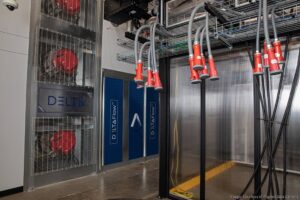
Aligned Data Centers partnered with DivCon Controls as it opened its advanced cooling lab in Phoenix, the first of its kind from the Texas-based data center developer. The one megawatt cooling lab is located on its north Phoenix data center campus — one of three campuses it operates in the Valley along with Chandler and Glendale. DivCon is also based in Texas.
“I’d like to think when [Aligned] looked around at their potential partners, they chose us because of our credibility and history,” Todd Dempsey, the president of DivCon, said of the partnership. “[The lab] was also a great learning and training opportunity for my team because eventually we’re going to run this new equipment out into the field on larger projects.”
Those cooling solution efforts culminated in the creation of the lab where Aligned continues working on its DeltaFlow~ technology — a patent-pending liquid-cooling solution — and Delta Cube, the data developer’s patent air cooling system. The cooling lab’s inception dates back two years, Aligned Chief Technology Officer Michael Welch recalled.
As the proliferation of data center development in the Valley and across the country surges amid the increasing demand of computing power for artificial intelligence, the need for more efficient cooling systems became evident, Welch said.
The great debate: Water-cooled vs air-cooled data centers
Industry-wide, there are a number of cooling solutions for data centers, but air-cooled systems remain almost exclusively the cooling solution of choice. Welch said an opportunity exists for liquid cooling to become prevalent as the power per rack inside data centers increases to accommodate the growth of artificial intelligence and cloud services.
Welch said the advanced computing systems for machine learning and inferencing from companies like Nvidia are “pushing the boundaries of those densities to enable better performance” and leading away from solely an air cooling system.
“The [thermal] density is driving this massive shift into liquid cooling from a heat absorption perspective,” Welch said of the power and energy capabilities of the servers on a single rack. “This is not new to the industry but it’s always been a smaller subset of what we did. Aligned said ‘We have to ready for this [shift] to move it from a smaller portion of our business to the majority of our business very quickly.’”
Liquid-cooling solutions can be categorized in three ways: direct-to-chip, immersion or hybrid approaches, which include air cooling. At the moment, Welch and Dempsey agree immersion isn’t as scalable due to a number of factors compared to direct-to-chip or the hybrid approach.
The eventual shift led to investing in the creation of a cooling lab to test its solutions — including DeltaFlow~ — and figure out how to scale the products into practice for future data center developments. This led Aligned to find a partner, DivCon, to help with control systems to deploy its liquid cooling solutions.
“[Aligned] needed a way to control the moving parts, pieces and the sequence of the operations of these DeltaFlow~ units they designed,” Dempsey said of DivCon’s role at Aligned’s cooling lab. “Our system holds the programming that controls the sequence of operations.”
Aligned Data Centers, a colocation data center developer, has all of its facilities “liquid cooling ready,” Welch said. Since Aligned leases out racks to third-party firms, they provide their customers with that option.
“Some of our facilities are going to stay air-cooled based on the workloads or traditional cloud or business applications,” Welch said. “Obviously we expect that significant portion of demand to go towards the advanced compute systems, and we’re liquid cooled, ready in all of our facilities across across the Americas.”
Public beginning to sour on data center development in Arizona
Aligned’s cooling lab comes online at a time when the public’s appetite for data centers in the Valley and throughout the state is in flux because of the strain put on local communities. Concerns about taxing the local power grid, noise pollution and high-water usage are chief among them for local residents.
“We data centers are the modern day backbone to the infrastructure age, and certainly we want to be there to support everybody’s use of these systems,” Welch said of the public’s growing dissatisfaction of data centers. “And I really do think that when done, when designed and built properly, the sustainability story of data centers is second to any industry in the [United States].”
The growing concerns has led to Mesa, Phoenix and Tempe to join Chandler as the four municipalities to numerate data center zoning laws and regulations. With few exceptions, even the municipalities who have enacted rules regarding future data centers in the Valley have not explicitly laid out how they will enforce water and energy use, let alone keep track of it.
Most recently, this public concern led Tucson City Council to reject Amazon’s proposed $3.6 billion data center project called Project Blue, per reporting from Arizona Luminaria. A few days after that project rejection, a Virginia Circuit Court Judge voided the rezoning for QTS Realty Trust LLC (NYSE: QTS) and Compass Datacenters LLC’s data center project near Washington, D.C., declaring three contiguous rezonings had no legal effect.
QTS Realty Trust has three Arizona data center projects — one operational data center in downtown Phoenix, a development on North 40th Street near Loop 202 in Phoenix and a third in Glendale.