
Pima Community College: Where Southern Arizona’s Workforce Begins
Pima Community College is working alongside industry partners to build the talent, training, and technology infrastructure Southern Arizona’s growing economy needs.
Southern Arizona’s economy is evolving, and Pima Community College is evolving with it. Growing industries like advanced manufacturing, aerospace and defense, cybersecurity, automation, and emerging technologies are creating new economic opportunities and demand for workers with the skills to power them.
“Building a nationally competitive ecosystem in AI, defense, and advanced manufacturing requires more than facilities and power grids. It starts with a capable workforce — the human infrastructure that makes growth possible. Pima Community College is that engine for Southern Arizona,” said Jeffrey P. Nasse, Ph.D., Chancellor of Pima Community College.
Training Built Around Industry
Pima works with more than 800 industry, public, and non-profit partners and 40 Business & Industry Advisory Committees to ensure programs respond to real workforce needs. Regional employers help shape curriculum, training, and opportunities for students to gain hands-on experience through work-based learning.
“We don’t train in a vacuum and hope employers hire our graduates. We co-create curriculum alongside companies like Raytheon, Caterpillar, and Bombardier, making sure our students step directly onto the factory floor or into the hangar job-ready on day one,” said Ian Roark, Ed.D., Provost and Executive Vice Chancellor for Academic Affairs and Workforce Development..
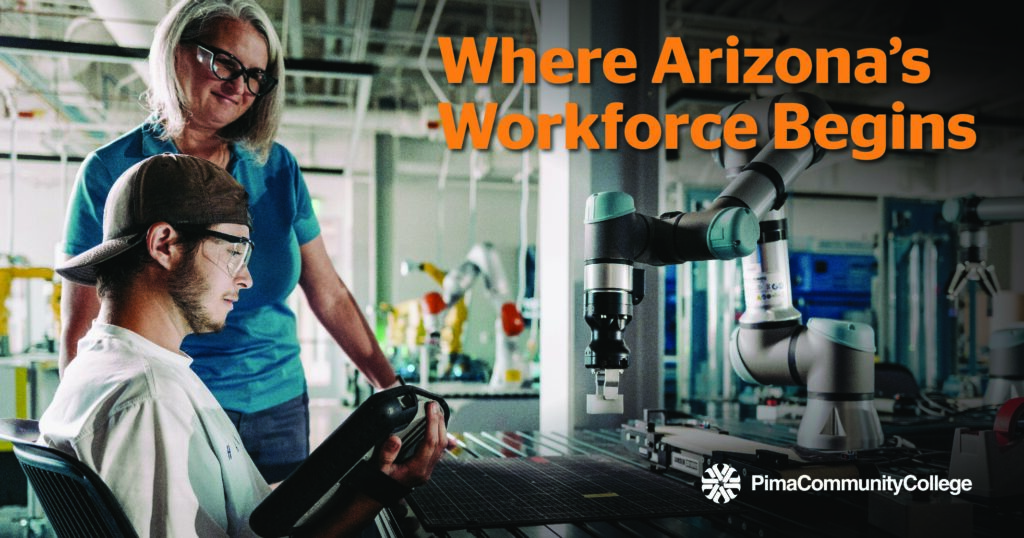
In Automated Industrial Technology, students learn robotics, sensors, smart machines, and automated assembly — the technology behind modern manufacturing. Partnerships with employers including Raytheon/RTX provide apprenticeship and employer-funded training opportunities, while Pima’s Flexible Industry Training (FIT) Lab allows Pima to develop customized upskilling programs around employer needs.
Pima’s Aviation programs apply the same industry-connected approach to Southern Arizona’s aerospace and defense sector. At the Aviation Technology Center, students train on live commercial aircraft in a 97,000+ sq. ft. facility at Tucson International Airport, with career-connected learning opportunities through industry partners including Bombardier and Ascent Aviation Services.
In Information Technology (IT) and Cybersecurity, students can put their skills to work before they graduate. Through a partnership with the Arizona Department of Homeland Security, students work in paid positions in a Regional Security Operations Center that helps protect public infrastructure across Southern Arizona.
These are just a few of the growing industries Pima has built Centers of Excellence around — dedicated, modernized learning and training facilities where students gain hands-on experience with the technology and equipment used in today’s workplaces.
Keeping Pace with What’s Next
While Pima’s Centers of Excellence represent some of the College’s most modern learning environments, many other facilities have yet to undergo the same transformation. Many of Pima’s classrooms, labs, and facilities date back to the 1970s and need modernization to keep pace with today’s workforce training. State capital funding for Pima ended in 2009, and regular state operational funding was eliminated in 2015.
This November, Pima County voters will consider Proposition 430, a proposed $250 million General Obligation Bond for Pima Community College. If approved, the bond would fund repairs and technology upgrades across the College, while also modernizing and expanding learning and training spaces for programs including First Responders and Public Safety, Arts, Education, Cyber and IT, and STEM. These projects are part of a broader list of proposed improvements across the College. Learn more about Proposition 430 and the projects it would fund.
Impact Beyond the Classroom
Pima’s role in workforce development has an impact well beyond its campuses. According to a Lightcast economic impact analysis based on FY2023-24 data, the College contributes $1.3 billion annually to the local economy and supports 16,651 jobs — about one in every 35 jobs in Pima County.
As technology continues to reshape nearly every industry, the connection between education and employers will only become more important. By developing programs alongside industry, creating accessible pathways into careers, and giving students opportunities to learn with the technology and equipment they’ll encounter on the job, Pima is helping prepare Southern Arizona’s workforce for what comes next.
Learn more about how Pima Community College is preparing Southern Arizona’s workforce through industry-connected education and training at pima.edu/workforce. Explore Pima’s campuses and Centers of Excellence at pima.edu/visit, or learn more about Proposition 430 and proposed investments at pima.edu/prop430.