
ASU researchers develop new technologies to increase US critical minerals, essential to national security
You may never have heard of gadolinium, praseodymium or dysprosium, but you use them every day in your smartphone’s display. They are a few of the 60 elements and minerals known as “critical minerals.” These materials power our lives and are vital to the economy, energy systems and national security.
Global supply chains that source, process and distribute these materials can be interrupted by trade issues, price swings or natural disasters. Losing access to even one critical mineral could disrupt entire industries, threaten U.S. energy security and production capacity, and put jobs at risk.
Why this research matters
Research is the invisible hand that powers America’s progress. It unlocks discoveries and creates opportunity. It develops new technologies and new ways of doing things.
Learn more about ASU discoveries that are contributing to changing the world and making America the world’s leading economic power at researchmatters.asu.edu.
New federal initiatives seek to increase domestic supplies of critical minerals and reduce dependence on foreign sources. Arizona State University researchers are advancing exploration, mining, recovery, recycling and supply chain innovations to support these goals.
“Arizona is a mining state, and so I think it’s important for Arizona to help the industry develop more efficient, more advanced technologies to recover minerals,” says César Torres, a researcher in the ASU Biodesign Swette Center for Environmental Biotechnology and a professor in the School for Engineering of Matter, Transport and Energy who studies critical mineral recovery.
“ASU is helping develop the new generation of technologies that will be used by the industry. We have the facilities, the infrastructure to rapidly test different technologies and see whether they have economic viability, whether they have scientific merit.”
What are critical minerals?
Critical minerals are the foundational materials needed for U.S. manufacturing, the economy and national security — and that have supply chains vulnerable to disruptions. The U.S. Geological Survey analyzes vulnerabilities and updates a list of these minerals every few years.
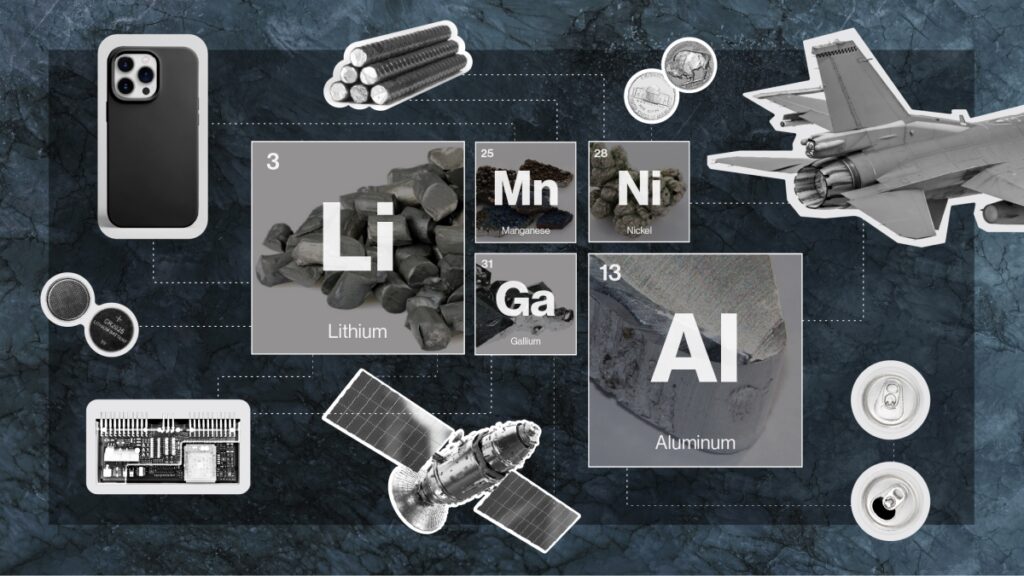
Some critical minerals are familiar materials. Aluminum, for example, isn’t only for soda cans and wrapping leftovers. It’s also vital for defense, aerospace, transportation and energy uses. Graphite, a form of carbon, has a soft, layered structure that allows pencils to write and helps hold and release energy in lithium-ion batteries.
Others are less known but equally important. For example, gallium, a soft metal that can melt in your hand, is used in semiconductors.
What is a mineral?
According to the U.S. Geological Survey, a mineral is a material that:
- Is naturally occurring.
- Is inorganic, meaning it is not made from living things.
- Is either an element (the fundamental building blocks of all matter) or a compound (made up of two or more elements).
- Has an orderly internal structure, characteristic chemical composition and a crystal form.
- Has physical properties (such as hardness, density and cleavage patterns) that reveal its structure and composition, which help identify the mineral and determine how it can be used.
What is a rare earth element?
Also called rare earth magnets, rare earth elements are a subset of critical minerals that have special physical and chemical properties. You can find most of them on the second-to-last row, at the bottom of the periodic table. Some are especially strong magnets, and others have light-emitting properties or increase the rate of chemical reactions. These characteristics make them useful for electric motors, medical technologies, defense systems and other electronics.
Rare earth elements are not as rare as their name suggests. Many are more abundant than silver, gold and platinum — but you won’t find a nugget of samarium. They only appear in small traces mixed with other minerals. They’re also difficult to separate out, requiring complex chemical processes to pull them apart from less useful elements.