
Raytheon’s new Navy radar variant aces first live maritime test in Hawaii
Story Highlights
- Raytheon’s AN/SPY-6(V)4 radar passed first live maritime test
- SPY-6 radar enhances detection capabilities for U.S. Navy destroyers
- Raytheon projects SPY-6 deployment on 65 Navy ships
A key radar system being developed in Tucson for the U.S. Navy by Raytheon, the missile-making arm of RTX Corp. (NYSE: RTX), passed its first live test in a maritime environment this week, the company said.
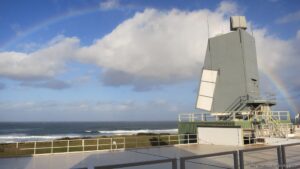
A series of tests of the AN/SPY-6(V)4 radar took place recently at the Advanced Radar Detection Laboratory at the Pacific Missile Range Facility in Hawaii. They took place over open water to track air and surface targets in a variety of conditions and scenarios, Raytheon said.
“The successful live demonstration of the SPY-6(V)4 radar is a major step forward in advancing the capabilities of today’s fleet and supporting allied operations worldwide,” said Barbara Borgonovi, president of Naval Power at Raytheon. “The radar will allow existing U.S. Navy Flight IIA Destroyers to significantly upgrade their detection and tracking capabilities, allowing sailors to more effectively monitor and respond to potential threats in real-time.”
The latest testing provides the first live data for the system’s (V)4 configuration, said Raytheon — one of Arizona’s largest defense contractors.
Raytheon has been working on the project for the past several years, winning a $651 million contract early in 2022 to produce and maintain the system. That contract had options that could increase its value to $3.2 billion, and in 2024, Raytheon built on it with a $677 million deal.
Some of the work under the contract has been performed in Scottsdale, according to previous Business Journal reporting, with several locations across the country involved.
The SPY-6 radar is designed to defend against ballistic missiles, cruise missiles, hostile aircraft and surface ships simultaneously. They increase detection range, sensitivity and discrimination over legacy radars.
Raytheon has said that SPY-6 technology is projected to be deployed on 65 Navy ships over the next 10 years. Earlier iterations of the system have already undergone testing and have been installed or produced for the Navy’s Aegis class of ships. The system’s enhancements use common hardware and software so they can be integrated and scaled more easily, Raytheon said.
Raytheon’s big year for billion-dollar deals
The latest testing comes a few weeks after Raytheon’s Tucson-based missile manufacturing operation partnered with German company Diehl Defense for production of Stinger missiles in Europe.
Raytheon has been on a hot streak this year, notably racking up multiple multibillion-dollar contracts, the freshest being a a $3.5 billion deal with the U.S. Air Force at the start of August.
That was the fourth and biggest contract worth $1 billion or more for Raytheon, further solidifying its position as the money leader in Arizona’s booming aerospace and defense sector — which has been on a growth streak with a number of cutting-edge projects.