
Tempe solar energy startup to appear in Google AI Super Bowl ad
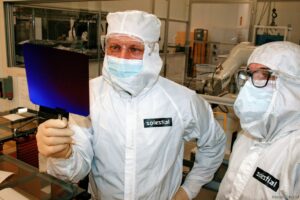
A Tempe-based solar energy startup is showcasing its technology in a Google Workspace TV commercial that will air during the Super Bowl.
Solestial Inc. is representing Arizona in Google Workspace’s “50 States, 50 Stories” ad campaign, which highlights how companies nationwide are leveraging artificial intelligence in their operations. The ad is slated to air Feb. 9 on Fox 10 Phoenix.
The ad, which features Solestial CEO Stan Herasimenka and other employees, illustrates the company’s solar cell technology used in space and how the startup is using Google Gemini AI for productivity management.
“It’s a mix of shots on site at the Solestial factory in Tempe with our team and some features of Gemini’s functionality,” Andy Atherton, Solestial’s chief operating officer, told AZ Inno. “We were super happy with how they integrated the two subjects.”
Solestial makes radiation-resistant silicon solar cells packaged in ultra-thin, flexible modules designed to withstand five- to 10-year missions in the harsh conditions of space. It produces its flexible solar power modules on automated machines at 10% of the cost of traditional solar cell products that are widely used in the industry, according to the company.
Google selected Solestial for its ad campaign from thousands of Workspace customers representing a variety of industries. Google leveraged its Gemini AI technology to narrow down the list to 500 companies and then used AI Studio to build a tool that reviewed and summarized interview transcripts. From there, it picked the final 50 participants for its ad campaign, according to the company’s website.
Google reached out to Solestial via email last fall to gauge interest in exploring potential marketing activities. The solar energy startup underwent a thorough vetting process before Google selected the company for its Super Bowl ad campaign, Atherton said.
Eileen Korte, Solestial’s head of marketing, worked closely with Google’s production team to ensure a smooth filming process at the company’s Tempe headquarters for its Super Bowl ad, which Atherton hopes can help the firm reach a broader audience and generate enthusiasm about the space industry in Arizona.
“I think getting Arizonans excited about space is probably at the top of the list,” he said.
Solestial to ramp up production in Tempe this year
Solestial has been steadily growing since raising $10 million in an oversubscribed seed round led by California-based Airbus Ventures in 2022.
“We’ve signed multiple binding contracts for flight hardware since that seed round closed,” Atherton said. “Our products have flown on multiple commercial spacecraft and performed as expected on all of those.”
What’s more, Solestial has landed $6 million worth of Small Business Innovation Research contracts with NASA, the U.S. Space Force, National Science Foundation and other government agencies.
Solestial also raised an undisclosed amount of funding in a series A round last year, which the company has yet to publicly announce, Atherton said. A regulatory filing shows Solestial raised $15 million out of a $21.9 million equity offering in September.
The company, which has 45 employees, is leasing more than 30,000 square feet across several suites at 1121 W. Warner Road in the Warner Business Center, where it’s ramping up production of silicon photovoltaics for space with plans to deliver 1 megawatt of solar modules per year by the end of 2025.
Solestial’s customers include major defense contractors and commercial clients.
In August, Solestial entered into a partnership with Switzerland-based photovoltaic company Meyer Burger to scale production of next-generation silicon solar technology for space.
Under the agreement, Meyer Burger is applying its silicon heterojunction technology to Solestial’s ultra-thin silicon wafers, which undergo metallization and integration into flexible solar power modules at the company’s Tempe facility.
“Our vision is to deliver abundant energy,” Atherton said. “The next bottleneck for human progress in space is the availability of energy, and our goal is to solve that.”