
Raytheon, Northrop Grumman win $81M contract for hypersonic missile work
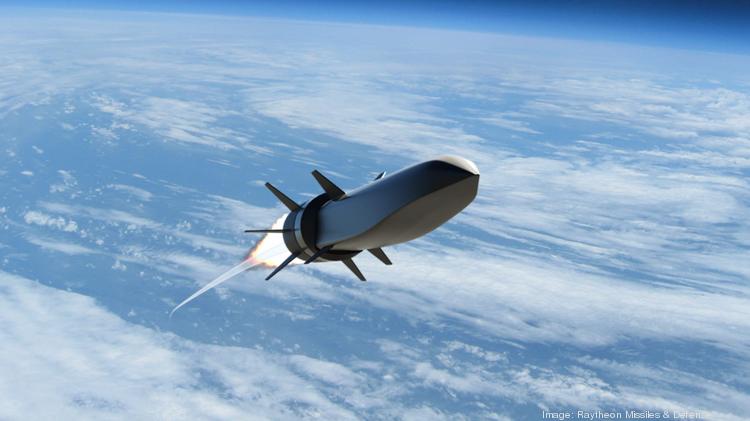
Raytheon and Northrop Grumman, which have been working jointly on a hypersonic weapon concept, were awarded an $81 million follow-on contract from the U.S. military for continued work on the project.
The joint effort centers around the Hypersonic Air-breathing Weapon Concept, or HAWC, for the Defense Advanced Research Project Agency and the U.S. Air Force. The two companies, both major players in the Arizona defense contracting scene, have been collaborating on the work since 2019, and have already completed multiple successful test flights.
Raytheon, a division of Arlington, Virginia-based RTX (NYSE: RTX), has its major missile manufacturing operation in Tucson. Northrop Grumman (NYSE: NOC), also based in Virginia, has major operations in Chandler. Nearly all of the new work will take place in Tucson.
The latest deal will focus on reducing risk for future air-breathing hypersonic systems, said Raytheon, which is leading the project. The team will build and fly more HAWC vehicles and use data from earlier stages of the program to improve the weapon’s design and manufacturing, Raytheon said.
“We applied learnings from each successful HAWC flight test to ensure that it is the most sophisticated system of its kind,” said Colin Whelan, president of Advanced Technology for Raytheon, in a statement. “Continuing this important program will expand our knowledge of hypersonic flight and allow us to deliver the critical capability our warfighters need.”
The HAWC vehicle’s overall design has been overseen by Raytheon, and Northrop Grumman has provided the scramjet engine. During testing, the HAWC has reached speeds greater than Mach 5, or five times the speed of sound, for more than 300 nautical miles as it reached altitudes higher than 60,000 feet.
Scramjet engines work by using high vehicle speed to forcibly compress incoming air before combustion to achieve sustained high-speed flights — thus they are described as “air-breathing.” They run on a widely available fuel and don’t need onboard oxidizers, both of which make for a safe, efficient and tactically sized long-range hypersonic weapon, Raytheon has previously said.
Raytheon also proceeding with cruise missile work
The contract modification brings the total cumulative face value of the contract to $352.95 million from $271.95, the Defense Department said.
The HAWC project will also bring airframe and engine design benefits to the U.S. Air Force’s Hypersonic Attack Cruise Missile, or HACM — another joint project of Raytheon and Northrop Grumman, which were awarded a nearly $1 billion contract in September to develop.
“The HAWC follow-on contract serves as an engine pathfinder program in our new production-ready Hypersonics Capability Center in Elkton, Maryland,” said Dan Olson, general manager and vice president, weapons systems, Northrop Grumman, in a statement. “Our factory of the future will seamlessly transition our validated propulsion system design into an operationally ready system to support further flight testing.”
Raytheon and Northrop Grumman are also working on a $97.7 million U.S. Army contract to develop a vital system for a new precision missile. That project is part of the Army’s Long Range Maneuverable Fires program and focuses on the DeepStrike-ER missile’s potential propulsion technology and it also involves an air-breathing system.
The announcement of the new contract modification comes as Raytheon also said it is opening a new facility at SkySong, The Arizona State University Scottsdale Innovation Center, that will employ 150 people and provide collaboration opportunities for students. It will be an engineering design hub with a focus on digital design products to support rapid growth of the company’s defense portfolio.